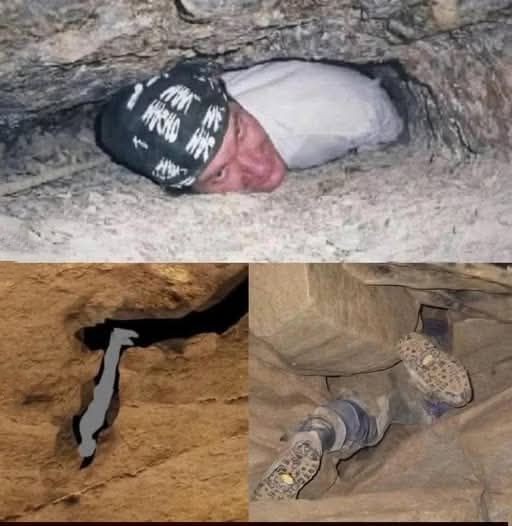
You don’t need to be inside the scene to understand it.
One glance is enough.
A tight, jagged crack in stone. A human body wedged deep inside it. Shoulders compressed, movement restricted, every inch of space taken away by rock that doesn’t yield or soften. It triggers something immediate in the mind—an instinctive discomfort, almost physical, as if your own body is reacting to the confinement.
This is how situations like this often begin—not with panic, but with curiosity.
Because exploration rarely feels dangerous at first.
Caves, narrow tunnels, hidden underground passages—they carry a certain appeal. They suggest mystery, discovery, and the possibility of seeing something few people ever will. To someone exploring, a tight opening doesn’t look like a warning. It looks like a challenge.
Something you can get through.
Something you can manage.
So you move forward.
Slowly. Carefully. Focused.
At first, everything seems under control.
Then the environment starts to change.
The passage narrows more than expected. The angles shift. The rock closes in just enough to remove the comfort of easy movement. And suddenly, what felt like progress turns into resistance.
Then realization sets in: turning back is no longer simple.
In moments like this, the body becomes both tool and limitation. Arms lose leverage. Shoulders press against stone. Legs, stretched behind, can’t generate enough force to reverse direction. Even breathing begins to feel different—not because the air is gone, but because the space around the chest refuses to expand freely.
That’s when the situation changes from physical difficulty to mental pressure.
Panic doesn’t arrive as a choice. It arrives as instinct.
The brain interprets confinement as threat. Heart rate increases. Thoughts speed up. Every instinct demands movement—push, pull, force, escape.
But the environment doesn’t respond to urgency.
Rock doesn’t yield to panic.
And the harder the struggle becomes, the more restricted the body can feel.
This is what makes tight-space entrapment so intense. It isn’t just about where you are—it’s about how your mind reacts to where you are. Claustrophobia can amplify every sensation: the space feels smaller, the air feels heavier, time feels distorted. Seconds stretch. Decisions become harder. Control feels distant.
In these situations, survival isn’t about strength.
It’s about control.
Experienced explorers understand this. They’re trained to resist instinct and replace it with strategy. Instead of forcing movement, they adjust it. Instead of rushing, they slow down. They reduce tension in the body, shift weight carefully, and look for the smallest possible changes that create even a fraction of new space.
Because in confined environments, progress is measured in centimeters—not force.
And sometimes, the most important action is stillness.
Pausing allows the body to settle. Breathing slows. Panic begins to fade just enough for clarity to return. And clarity is what makes problem-solving possible again.
Of course, prevention matters just as much as response.
Cave systems and narrow formations are unpredictable. A passage that looks manageable can tighten without warning. A safe-looking route can suddenly become a trap-like squeeze point. Even experienced explorers rely heavily on preparation—proper lighting, protective gear, mapped routes, and awareness of escape paths.
Without those safeguards, risk increases dramatically.
And when things go wrong, options shrink quickly.
What makes scenes like this so compelling is not just the danger itself, but what it reveals about human behavior. Curiosity drives exploration. Curiosity pushes people into unknown spaces. It fuels discovery, science, and adventure. But it also requires boundaries—because not every space is designed for human return once entered too deeply.
There’s a fragile balance between curiosity and caution.
And when that balance tips, consequences follow.
Whether a situation like this ends in rescue or self-extrication depends on patience more than power. Small adjustments matter: repositioning the shoulders, reducing pressure points, controlling breath, and moving only when the body allows—not when panic demands it. Sometimes external guidance is needed. Sometimes progress is barely visible from moment to moment.
But nothing about it is immediate.
And nothing about it is simple.
What remains after such an experience is not just relief, but awareness. A deeper understanding of how quickly control can disappear, and how environments that seem inviting can become restrictive without warning.
It becomes a reminder that nature does not adjust itself for human comfort.
It doesn’t negotiate.
It doesn’t pause for panic.
It simply exists.
And entering it demands respect.
In the end, this isn’t just a story about someone stuck in a narrow space.
It’s a reflection of something broader.
The tension between curiosity and caution.
The difference between exploration and overreach.
And the quiet realization that sometimes, survival doesn’t come from pushing forward harder—but from slowing down, thinking clearly, and finding a way through without forcing what cannot be forced.
If this made you think differently about exploration and risk, share your thoughts—and join the conversation about how far curiosity should really be allowed to go.