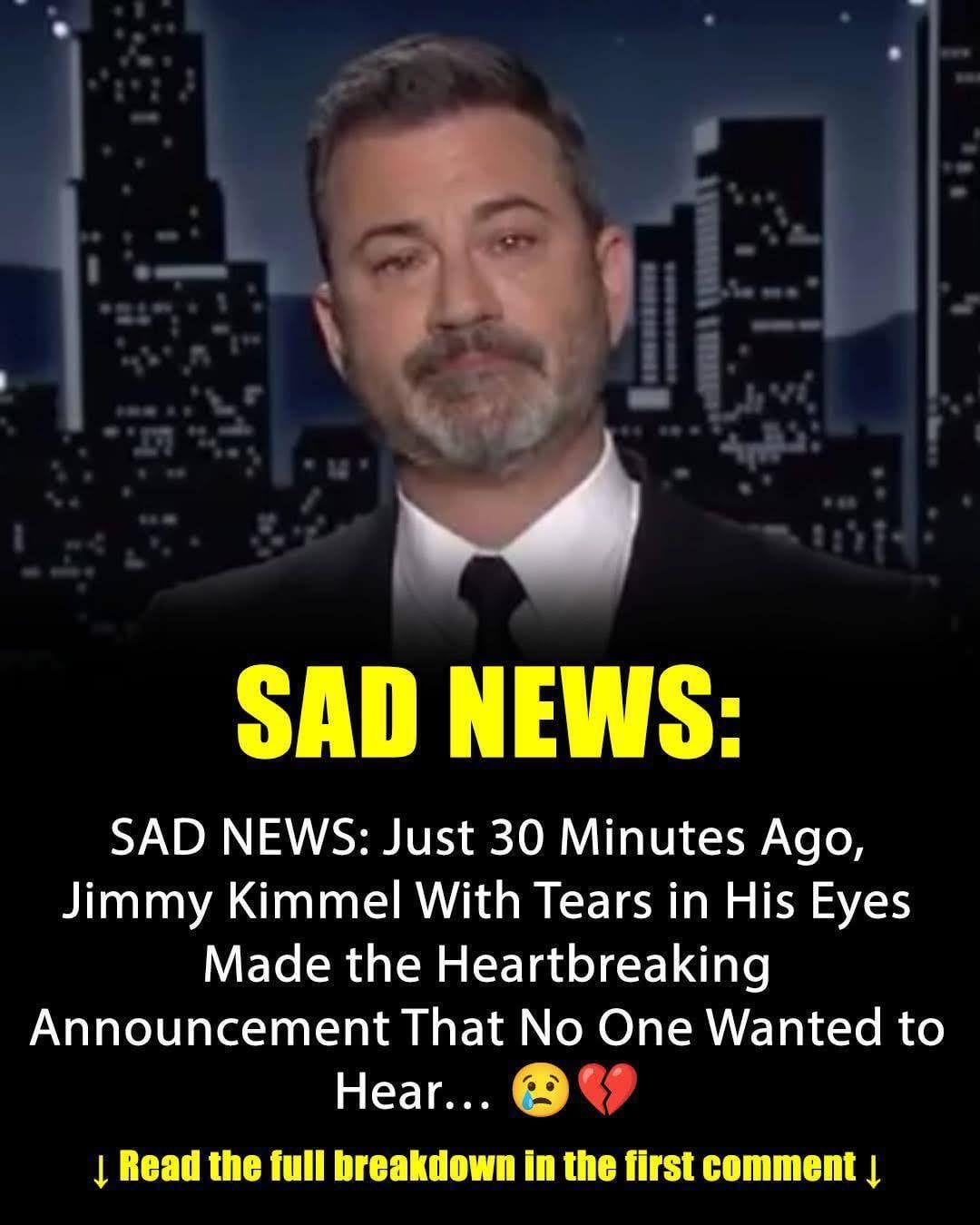
When the studio lights dimmed and the familiar music faded, the audience expected the usual sharp-witted banter and lighthearted jabs that had become the hallmark of late-night television. Instead, millions of viewers tuned in to witness a moment that shattered the traditional boundaries of entertainment, leaving an entire nation stunned. Jimmy Kimmel walked onto the stage not with his customary confident stride, but with a heavy, visible burden that instantly silenced the room. In a world increasingly saturated with digital noise and carefully curated public personas, the beloved television host stripped away his professional armor to confront a stark and uncomfortable reality. He was not there to deliver punchlines or offer a comforting escape from the daily grind. Instead, he was there to process a personal betrayal of the future he had envisioned for his children and his country. What unfolded in front of the camera was less a rehearsed monologue and more a raw, unfiltered public reckoning that left an indelible mark on the cultural landscape.
The emotional weight of the moment was palpable from the very first syllable. With a voice that wavered and eyes shimmering with unshed tears, Kimmel addressed the election results and the victory of Donald Trump. He spoke with the cadence of a man who understood the profound implications of the political shift, cutting through the abstract debates that often dominate the news cycle. Every policy and political maneuver, he argued, was not merely a theoretical disagreement to be hashed out by pundits on cable news; it was a force that would land directly on the lives of everyday Americans. He listed those he feared would be hurt the most by the new administration, including immigrants, patients relying on the healthcare system, seniors, working families, and allies abroad. It was an exhaustive list born of genuine empathy and deep-seated anxiety, highlighting the vulnerability of those already living on the margins. He spoke not as a television personality with an elite platform, but as a father and a citizen who felt the foundational values of his nation slipping away.
The atmosphere inside the studio was thick with tension as Kimmel laid his grief bare. As his voice faltered, the audience instinctively tried to lift him with a wave of applause, a desperate and well-intentioned attempt to return to the comfort of the status quo. They wanted to laugh, they wanted to be reassured, and they wanted to believe that everything was going to be fine. Yet, the heaviness in the room never truly lifted. The applause died down, giving way to an uncomfortable silence that spoke volumes about the state of the country. This vulnerability did not just reveal his political leanings; it unveiled a deeper, more profound fear that the United States might be fundamentally shifting away from the core values Kimmel believed were universally shared. It was a stark reminder that even those who are paid to bring joy into our living rooms are subject to the same crushing anxiety that keeps millions of Americans awake at night.
As expected, the reaction to the monologue was as swift, sharp, and divided as the fractures of the nation itself. Within minutes of the broadcast ending, social media erupted into a fierce debate over the role of entertainment in a highly polarized society. Critics immediately accused the host of hijacking a platform designed for comedy and turning it into a partisan lecture. They argued that late-night television should remain a sanctuary, a safe haven from the toxicity of the political cycle and the endless barrage of bad news. For these viewers, the stage should be used to entertain, not to dictate moral or political views. Conversely, his supporters saw the moment as an act of profound courage and necessary human honesty in a media landscape often built on distraction and superficiality. To them, he was a man who refused to hide behind a facade of easy jokes when his heart was clearly breaking, providing a voice for millions who felt the exact same way.
That polarization is precisely why this monologue has continued to endure in the public consciousness long after the cameras stopped rolling. It captured a profound divide in American life, expressed in real time through a man whose primary job is to help people forget their worries—only to stand before them and admit, with trembling lips, that he could no longer forget his own. It dismantled the illusion of detachment that is so often expected of public figures. The monologue highlighted the exhaustion that many feel as they watch the political landscape evolve, struggling to find a sense of stability in an unpredictable world. It was a mirror held up to society, forcing viewers to confront the reality that the divisions in the country are not just political, but deeply personal, affecting how people view the future of their families and the fabric of their communities.
In that quiet moment between his words, Jimmy Kimmel did not just share his own profound sadness; he invited an entire nation to sit with its own. He proved that sometimes, the most powerful and revolutionary thing a public figure can do is stop pretending that everything is okay. The aftermath of the broadcast continues to resonate across various platforms, reminding us that we are navigating an era defined by deep uncertainty and emotional turbulence. The debate over whether politics belongs in comedy may rage on, but the undeniable truth is that the emotional core of that night touched a nerve that cannot be easily dismissed. It remains a testament to the power of authenticity in an artificial world, showing that when the heavy realities of life come knocking, sometimes the most honest response is to simply let the mask fall and speak the truth, no matter how uncomfortable it might be.