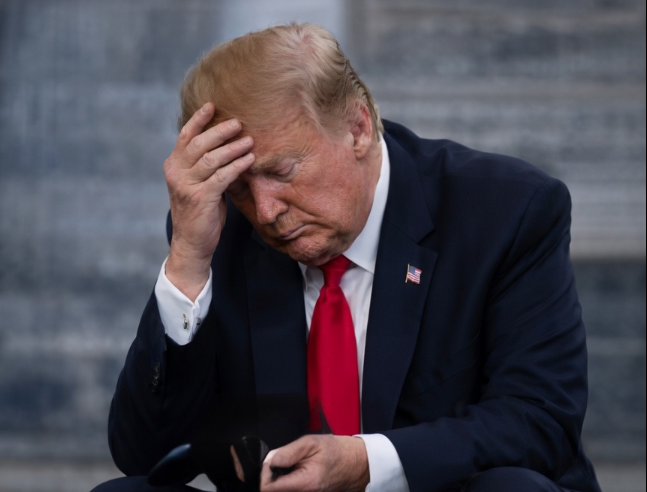
Donald Trump in Washington, D.C., emphasizing how history is often shaped not only by dramatic events but also by subtle periods of reflection and transition. Unlike the rallies, speeches, and controversies that have long defined Trump’s public image, this moment was marked by stillness and restraint. Observers noted a visible change in demeanor—not weakness or surrender, but a quieter awareness of consequence and legacy.
The piece argues that Trump’s political identity has always been built on momentum, confidence, and an unwavering projection of authority. Throughout years of legal challenges, political battles, electoral setbacks, and intense public scrutiny, he maintained an image of determination and defiance. Yet during this brief period in Washington, removed from the noise and spectacle that usually surrounded him, a different picture emerged. The contrast between his past dominance and the calm atmosphere around him drew attention to a broader reality: power eventually gives way to judgment.
Rather than presenting the moment as a political event, the article frames it as a human one. It suggests that Trump appeared less as a political symbol and more as an individual confronting the consequences of decisions that had moved from active debate into historical record. Actions once defended, criticized, or contested were no longer abstract political issues; they had become part of the story future generations would evaluate. In this sense, accountability—whether legal, political, or historical—had become immediate rather than theoretical.
The article emphasizes that leadership does not end when someone leaves office. Instead, its effects continue through institutions, public memory, laws, precedents, and civic culture. It argues that the most important chapters of a leader’s story often unfold after formal power has ended, when events are examined through the lens of history rather than political strategy. For Trump, whose presidency transformed American politics and public discourse, this period of assessment may ultimately prove as significant as the years he spent in office.
A major theme is the importance of quiet moments in understanding history. While headlines often focus on speeches, elections, and major decisions, historians frequently look to less dramatic moments for insight. Expressions, pauses, and changes in behavior can reveal how leaders respond when they are no longer directing events but instead facing evaluation. The article suggests that silence can sometimes communicate more than rhetoric, especially when it occurs during periods of transition.
The atmosphere in Washington itself is portrayed as reinforcing this idea. Government institutions continued to function normally, but without the urgency and attention that once followed Trump everywhere. This contrast highlighted a universal truth about leadership: authority is temporary, but the consequences of leadership endure long after power fades.
The article also notes that interpretations of such moments are often subjective. Supporters and critics may read different meanings into the same scene, projecting their own hopes or concerns onto a leader’s actions. Yet beneath those competing narratives lies a broader reality shared by all public figures: no one leaves power unchanged.
Ultimately, the piece argues that Trump’s legacy will not be determined solely by court rulings, political victories, or personal statements. Instead, it will be shaped by how citizens, institutions, and future generations interpret the lasting effects of his presidency. The article concludes that the quiet thirty-minute interval in Washington represented a threshold rather than an ending—a moment when spectacle gave way to reflection and history began its slower process of judgment. In that stillness, it suggests, the long-term meaning of leadership started to come into sharper focus.