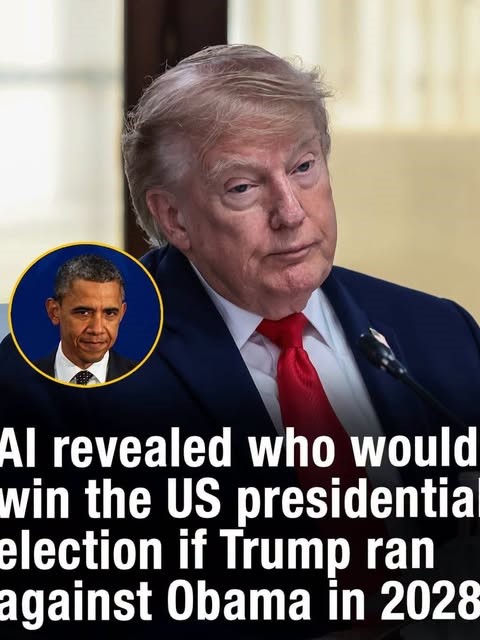
A political “what if” is igniting debate: Donald Trump hints at a third term, and suddenly Barack Obama is pulled back into the spotlight. When an AI is asked who would win a hypothetical 2028 showdown, its answer is strikingly blunt—and deeply provocative.
In this imagined scenario, the AI doesn’t picture a routine election. Instead, it sees a nation worn down by years of division, scandal, and nonstop political conflict. Voters, in this view, are less interested in policy details and more focused on emotional relief.
The model predicts Obama would center his campaign on restoring stability, framing himself as a corrective force after what he would describe as prolonged disruption. His message would likely emphasize unity, predictability, and institutional repair.
Trump, by contrast, would continue to lean into his signature style—disruption, confrontation, and outsider energy. His appeal would remain rooted in challenging the system rather than calming it.
According to the AI, this clash becomes less about ideology and more about temperament. It frames the race as a referendum between order and upheaval, familiarity and friction.
In that context, the AI leans toward a “fairly confident” Obama victory. Its reasoning suggests that, in an exhausted political climate, voters might prioritize stability over intensity.
However, the entire premise is legally impossible. The Twenty-second Amendment to the United States Constitution prohibits any U.S. president from serving more than two terms, blocking both candidates from such a scenario.
That’s what makes this thought experiment resonate. It’s not really about 2028—it’s about what voters value: limits on power, the tone of leadership, and whether the country craves calm or confrontation in its future.