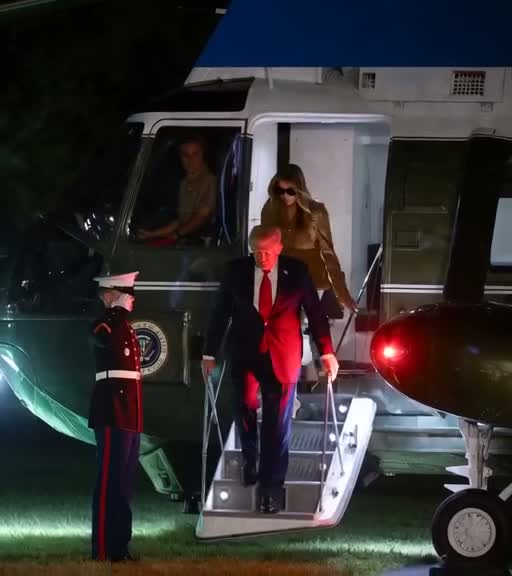
The rotors screamed over the English countryside when something went wrong. Marine One, carrying President Trump and Melania, was suddenly in trouble.
A “hydraulics issue,” officials said. The helicopter made an emergency landing, forcing a rushed switch to a backup aircraft.
Minutes stretched into tension. What should have been a short, routine hop became an unexpected ordeal in midair.
The unscheduled descent onto a local airfield turned a 20-minute flight into a 40-minute disruption, exposing how fragile even tightly planned state visits can be.
Yet the moment quickly shifted. As the Trumps lifted off again toward Stansted, the narrative moved from crisis to control.
The incident added drama to a high-stakes day already defined by ambition and political theater.
At Windsor Castle and Chequers, Trump met King Charles III and Prime Minister Keir Starmer, presenting the visit as a turning point in U.S.–UK relations.
At the center was a £250 billion “tech-prosperity” pact—spanning private investment, nuclear energy, artificial intelligence, quantum computing, and future 6G infrastructure.
The agreement emphasized deregulation, rapid innovation, and deep economic alignment between the two countries.
By the time Trump returned to the White House, the message was clear: even when the aircraft falters, the broader mission continues.
The brief scare in the sky became a symbol—not of weakness, but of resilience under pressure.
In the end, the visit was framed less by turbulence and more by its sweeping ambitions.
A moment of uncertainty had been absorbed into a larger narrative of momentum, risk, and strategic partnership.
Even amid disruption, the projection remained the same: control, confidence, and forward motion.