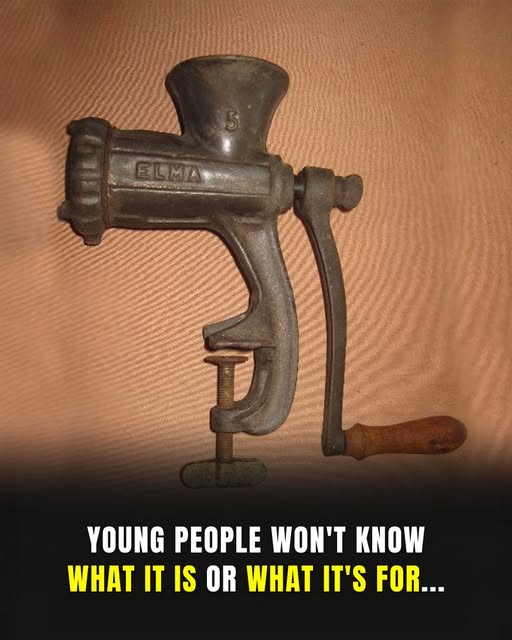

A peculiar metal device with a crank recently caught the internet’s attention. Behind this puzzling object, some people eventually identified a tool that was once extremely common… in our grandparents’ kitchens.
A curious metal machine, somewhat plain in appearance, fitted with a crank and an unusual shape… that was enough to spark a wave of curiosity across social media. Thousands of users studied the photo, trying to determine the purpose of this object from another time. A forgotten gadget? A mysterious device? A piece of workshop equipment? The guesses kept coming. Yet the answer may have been hiding in the most ordinary place… our grandparents’ kitchens.
The Mysterious Object That Confused the Internet
It all began with a simple photo posted online: a solid metal device featuring a crank and a round opening.
Very quickly, comments started pouring in. Some believed it was an old mechanical instrument, while others assumed it was a farming tool or an industrial object.
But a few more attentive users quickly recognized the familiar item.
It was actually a manual meat grinder, a kitchen tool that was once extremely common in household kitchens.
Before electric appliances and modern food processors became widespread, this small device was essential for preparing many homemade meals.
For an entire generation, its shape immediately brings back memories of dishes prepared with patience and care.
A Once-Essential Kitchen Tool

The operation of a manual meat grinder is both simple and ingenious.
The device is typically fixed to the edge of a table or countertop using a tightening clamp. Pieces of meat are then placed into the opening at the top.
By turning the crank, an internal screw mechanism pushes the meat forward toward a perforated plate at the end of the device.
The result: the meat emerges in thin strands, perfectly ground.
This mechanical system made it easy to prepare many popular dishes: fillings, meatballs, ground steaks, or homemade mixtures.
At a time when most food was prepared entirely at home, this tool saved considerable time.
An Invention From the 19th Century
The origins of this device go back to the 19th century, a time when many practical household tools were being invented.
One of the earliest versions of the mechanical meat grinder is often credited to the German inventor Karl Drais, known for creating practical and clever inventions.
His concept was simple: design a mechanism that could quickly turn pieces of meat into ground preparation without requiring too much effort.
With the help of a crank and an internal screw, the device could produce consistent results while remaining completely manual.
At the time, this invention represented a small breakthrough in meal preparation.
It made certain recipes easier to prepare and simplified kitchen work.
When Culinary Memories Return
While some internet users were seeing the object for the first time, others recognized it immediately.
Many said they remembered seeing one in their grandparents’ kitchens, often stored in a drawer or hanging near the countertop.
For them, the image sparked a strong sense of nostalgia.
Some recalled the distinctive sound of the crank turning, while others remembered helping in the kitchen while family meals were being prepared.
This type of object reminds people of a time when cooking moved more slowly—but was also more handmade and personal.
Modern Versions… But the Old Model Still Exists

Today, electric grinders have mostly replaced these manual models.
They allow people to prepare large amounts of food within seconds and often include multiple attachments for different types of preparation.
However, the manual grinder has not completely disappeared.
Some people still prefer using it, attracted by its simplicity, durability, and authentic character.
With no electricity required, easy cleaning, and extremely sturdy construction, it remains a dependable tool for those who enjoy homemade cooking.
And sometimes, all it takes is an old photo shared online to remind us that even the simplest objects can carry meaningful stories from everyday life.