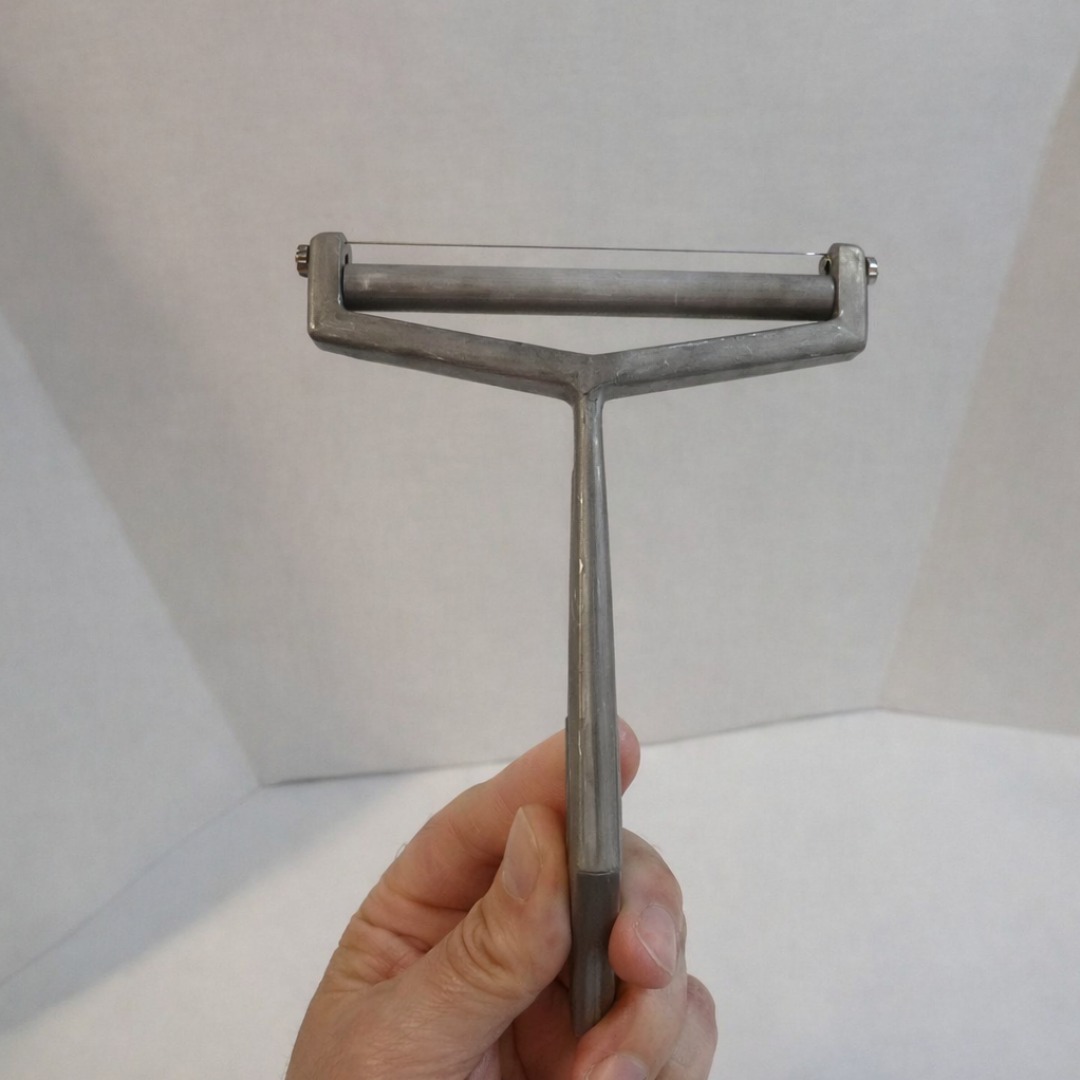
The object in the image looks deceptively simple: a T-shaped, all-metal tool with a horizontal roller-like bar across the top and a sturdy handle below. It’s the kind of thing you could easily mistake for a niche hardware gadget, a vintage razor, a craft tool, or even a part missing from a larger machine.
But the answer is far more delicious than most people expect.
It’s a cheese cutter.
Why This “Mystery Tool” Confused So Many People
At first glance, the tool doesn’t scream “kitchen.” There are no obvious blades, no labels, and no modern plastic parts. Instead, it has a utilitarian, old-school build that feels like it belongs in a toolbox rather than beside a cutting board.
A few reasons it stumped people:
- Minimalist design: It’s built to do one job well, without extra features.
- All-metal construction: Many people associate kitchen tools with wood, plastic, or stainless styles that look more “modern.”
- Not commonly seen today: Plenty of households use pre-sliced cheese or standard knives, so specialty cutters feel unfamiliar.
- Looks like another category of tool: The T-shape leads people toward guesses like paint rollers, scrapers, peelers, or vintage grooming devices.
The Reveal: What a Cheese Cutter Actually Does
A cheese cutter is designed to portion, slice, or shave cheese more cleanly and consistently than a typical knife, especially when working with semi-soft to firm cheeses.
Depending on the specific style, a cheese cutter can help you:
- Create even slices for sandwiches and platters
- Shave cheese into thin, attractive layers for garnishing
- Portion cheese without crushing it (a common issue with dull knives)
- Improve safety and control by using a tool designed for the texture of cheese
In short: it’s a purpose-built slicer that turns a block of cheese into neat servings with less mess.
Key Features You’re Looking At in the Photo
This particular cheese cutter has a classic, durable build. Even without branding, the design gives away its function once you know what to look for.
- T-shaped frame: Provides leverage and stability during slicing
- Top bar/roller assembly: Helps guide movement smoothly across the cheese surface
- Sturdy handle: Allows pressure and control without slipping
- Simple mechanics: Fewer moving parts means it lasts for years (sometimes decades)
How to Use a Cheese Cutter (Simple and Clean)
If you’ve never used one, it’s straightforward. Here’s a practical method that works for most cheese cutters:
- Choose the right cheese: Best results come with semi-soft to firm cheeses (cheddar, gouda, provolone, etc.).
- Chill the cheese slightly: Cold cheese holds shape better and slices more cleanly.
- Stabilize the block: Place it on a flat cutting board to prevent slipping.
- Position the cutter: Set the top bar against the surface where you want your slice to begin.
- Apply steady pressure: Pull or glide the cutter smoothly, keeping your angle consistent.
- Repeat with the same motion: Consistency produces uniform slices and avoids crumbling.
Important tip: If the cheese is very soft (like brie), many people prefer a cheese wire or a thin blade instead. If it’s very hard (like aged parmesan), a hard-cheese knife or wedge tool can be more effective.
Why Vintage Cheese Cutters Are Making a Comeback
Once people learn what the tool is, the next reaction is usually: “Wait… why don’t we all still use this?”
The truth is, these tools never stopped working—people simply stopped seeing them.
Here’s why they’re returning to kitchens:
- Better presentation: Cheese boards and home entertaining are popular again
- Less waste: Clean slices mean fewer broken chunks and crumbs
- Durability: Many older cutters are built like industrial tools and outlast cheaper modern gadgets
- Satisfying to use: There’s a tactile, controlled feel you don’t get from forcing a knife through a dense block
Common “Wrong Answers” People Guess Online
When this type of tool goes viral, you’ll often see the same guesses pop up repeatedly:
- “A weird razor”
- “A paint or glue roller”
- “A pastry tool”
- “A leatherworking gadget”
- “A vintage kitchen tool… but for what?”
The funniest part is that many of these guesses aren’t absurd—the tool’s shape overlaps with multiple categories. That overlap is exactly what makes it such a perfect internet mystery.
The Takeaway
A simple photo reminded everyone of a modern truth: we’ve lost familiarity with a lot of everyday tools that used to be common in homes. What once sat in a kitchen drawer now looks like an artifact from another world.
But the punchline is wonderfully ordinary.
It’s not a rare invention. Not a mechanical oddity. Not a secret gadget.
It’s a cheese cutter—built to slice cleanly, last forever, and quietly do its job.